
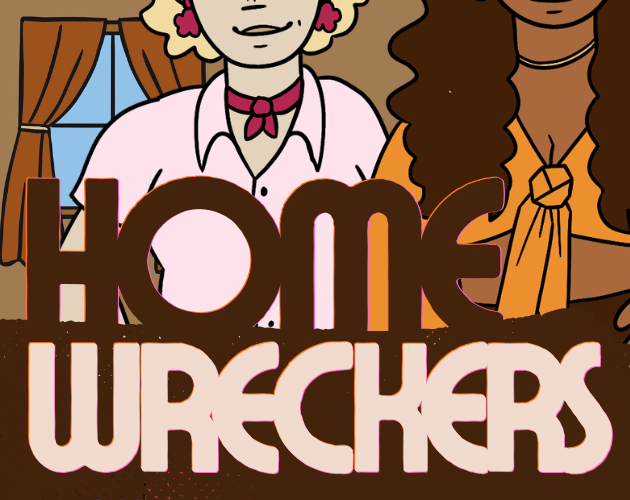
HOMEWRECKERS
MONTREAL, 1970s: Following the disappearance of your spouse, you're left with a large sum of money and the house to your name. Time to turn this place into your dream home... finally, a place just for you!
HOMEWRECKERS is an anti-home management narrative game about community-building, surveillance, and practicing queer failure / queer resistance via blurring of the lines that divide the public sphere from the private spheres.
FEATURES:
- Two possible endings!
- Period-inspired furniture!
- Five
squatterscolourful friends to chat with, old and new! - Your home, your way!
- Mouse to interact
- C to open / close your furniture catalogue
- Arrow keys to scroll the main house
KNOWN BUGS:
- Unfortunately, the dialogue panel currently does not follow the camera within the main house. When clicking on NPCs to interact, please scroll back to the leftmost edge of the house to read dialogue. Sorry for the inconvenience!
- Floor items currently cannot be interacted with directly and can only be "assembled" by asking for help
SPECIAL THANKS:
- Background art: Chai T. [@fantazychai]
- Character & asset art: Zosia R. [@zoflo]
- Additional buttons: game-icons.net, juliladstatter
- Programming assistance: Eve G. [@eveeeveve]
- Pricing/scoring & catalogue layout: Rex T. [@t-rex-thriving]
- Additional SFX: jalastram, kronbits, pixabay.com
- Furniture modelled after Ikea catalogues from 1960-1970
Designed and developed in one week by Atlas G. [@asterythm] as a final project for ENGL 391 (Special Topics: Queer Montreal) at McGill University. Click to expand a detailed explanation of the themes explored in HOMEWRECKERS.
THESIS: The neoliberal ideal of the private sphere paints a picture of a space all your own that promises autonomy, agency, safety, and independence from external control or observation — a space where you can exist authentically as yourself. However, in practice, the private sphere often fails to deliver on these promises, instead representing enclosure, isolation, and exclusion, especially for those who fall outside societal norms. In the face of a system that leaves no room for queerness in the public or the private sphere alike, queer resistance can and must be found by rejecting the division of the private and public sphere and its associated boundaries altogether as we carve out our own spaces with our own rules, conducting “private” activities such as sexual or romantic intimacy in public spaces, while opening up private spaces with “public” activities such as community-building and organization.HOMEWRECKERS is a subversion of the decoration / management game genre.
The mechanics — the literal “system” by which you are scored — encourage you to keep building the home to serve exclusively yourself / match a heteronormative, nuclear-family structure, so that those who prioritize getting that which is typically associated with respect and high performance in the context of games (ie. a high score) will also end up with a home that most closely resembles the societal expectation for this type of private space. Likewise, the home decor catalogues you receive all feature advertisements to continually reinforce the idea of the home as somewhere for you and your husband (the target audience for these catalogues is housewives!) to enjoy complete safety and freedom to raise your family and live how you want to live.
The narrative, meanwhile, runs counter to these mechanical elements, encouraging you to practice the “queer art of failure” instead, getting a lower score as you instead transform your private dwelling into a public space / pseudo-safe house within a Montreal that remains unsafe for queer people to live as they are. It is your choice whether or not to invite most of your potential “guests” into your home; your choice how you treat them if you do.
Regardless of what choices you make, however, the illusion of your home as a private, safe space is gradually peeled away over the course of the game as the boundary of your home is shown to be prone to breaching / already compromised in several ways, both in obvious and innocuously mundane (read: insidious) ways throughout the game. The game always culminates in your home — including, notably, your room, which no one else ever enters throughout the entire game even as you do accept guests — being invaded by police at the end, representing a total breakdown of the private sphere and all that it offered.
Download
Leave a comment
Log in with itch.io to leave a comment.